Home
Snurblog — Axel Bruns

Main navigation

  • Home
  • Information
  • Blog
  • Research
  • Publications
  • Presentations
  • Press
  • Creative
  • Search Site

Elections

Snurb — Tuesday 5 January 2016 16:00

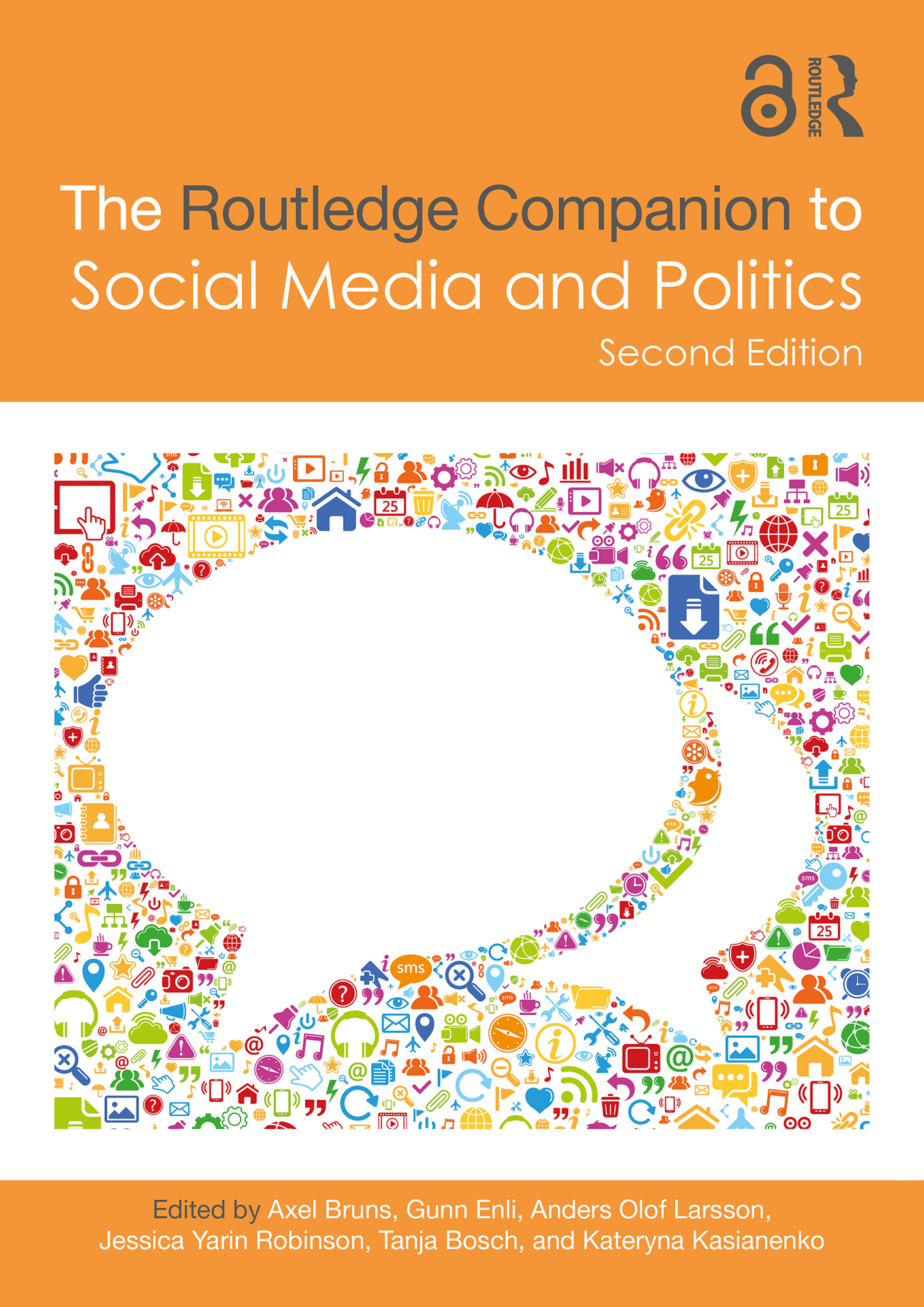
Now Out: The Routledge Companion to Social Media and Politics

Politics | Elections | Journalism | Social Media | ARC Future Fellowship | Publications |

It looks like 2016 is destined to start with a bang rather than a whimper: I’m delighted to announce that a major collection I’ve edited with my colleagues Gunn Enli, Eli Skogerbø, Anders Olof Larsson, and Christian Christensen in Oslo and Stockholm has now been published. The Routledge Companion to Social Media and Politics is a 37-chapter, 560-page collection of current research on the uses of social media in political activism and electoral campaigning.

From Anonymous to the Scottish Independence Referendum, from oppositional politics in Azerbaijan to elections in Kenya, the Companion covers a broad range of social media uses …

» continue reading...
Snurb — Saturday 24 October 2015 08:15

Social Media Messaging Types by US Gubernatorial Candidates

Politics | Elections | Social Media | AoIR 2015 |

Up next in this AoIR 2015 session is AoIR president Jenny Stromer-Galley, whose focus is on the social media use of US gubernatorial candidates. Their tweeting activities are linked of course to the very lengthy US electoral process from surfacing candidates through primaries and nominating conventions to the elections themselves.

Most of the research into social media use during these elections tends to aggregate general election messaging, but this is strongly affected by a variety of external factors, too. There are some fairly established rhythms of general elections: from early strategic messaging through mid-campaign debates and mobilisation to end-game reinforcement …

» continue reading...
Snurb — Saturday 24 October 2015 07:59

Social Media in Australian Elections through the Years

Politics | Elections | Social Media | Twitter | AoIR 2015 |

The next AoIR 2015 paper is by Tim Highfield and me, and I'll add I've added our presentation slides below as soon as I can. The paper will also be a chapter in the forthcoming Routledge Companion to Social Media and Politics, which my colleagues Gunn Enli, Eli Skogerbø, Anders Larsson, Christian Christensen and I have edited – and which will appear in early 2016.

Social Media in Selected Australian Federal and State Election Campaigns, 2010-15 from Axel Bruns and Tim Highfield
» continue reading...
Snurb — Saturday 24 October 2015 07:11

Social Media and Elections in Sweden since 2010

Politics | Elections | Social Media | Twitter | AoIR 2015 |

The post-lunch session at AoIR 2015 is a panel on social media and elections that my colleague Tim Highfield and I are contributing to, but we begin with the excellent Anders Olof Larsson, whose focus is on recent Swedish elections. Sweden traditionally has a high level of election participation and substantial Internet and social media access, and social media have become increasingly visible in election campaigns, unsurprisingly this has increased over time.

The project followed the election-related hashtags #val2010 and #val2014, and there has been a substantial shift from making undirected statements on Twitter to using retweets to disseminate other …

» continue reading...
Snurb — Saturday 24 October 2015 02:58

Tweeting Styles of Candidate Accounts in US Gubernatorial Contests

Politics | Elections | Social Media | Twitter | AoIR 2015 |

The next speaker at AoIR 2015 is Sikana Tanupabrungsun, whose focus is on the use of Twitter by gubernatorial candidates in 36 state elections across the United States in 2014. The focus here is on @mentioning between candidates, and the analysis was conducted using automated content analysis approaches. This found that the most frequent mode of address was to attack other candidates.

Online campaigns have been studied for several years, and a general finding is that incumbents employ more position-taking strategies, while challengers operate more often in attack mode. This may play out on Twitter slightly differently because of the …

» continue reading...
Snurb — Friday 23 October 2015 05:21

Does Humour Belong in Politics (on Twitter)?

Politics | Elections | Social Media | Twitter | AoIR 2015 |

The next speakers at AoIR 2015 are Kristen Guth and Alex Leavitt, who begin by highlighting Twitter's 2015 attempts to reduce the plagiarism of jokes by retweeting. Their real focus is on humour during the 2012 presidential debates in the US, though, and they focus on the three presidential debates during the campaign.

The team used live coding and dynamic keyword management during the debate, to capture as much as possible of the Twitter discussion around the debates. This resulted in 427 linguistic rules capturing some 33m tweets from 5.4m users, of which some 51% were retweets.

Audiences and journalists …

» continue reading...
Snurb — Thursday 6 November 2014 09:55

Twitter in the 2013 Australian Election (CMPM 2014)

Politics | Elections | Social Media | Social Media Network Mapping | Twitter | CMPM2014 |

Australia New Zealand Workshop on Campaign Management and Political Marketing (CMPM 2014)

Twitter in the 2013 Australian Election

Axel Bruns

  • 17-18 July 2014 – Australia New Zealand Workshop on Campaign Management and Political Marketing, Sydney
Twitter in the 2013 Australian Election from Axel Bruns
» continue reading...
Snurb — Thursday 6 November 2014 09:49

All Politics Is Local? The Twitter Performance of Local Candidates in the 2013 Australian Federal Election (ASMC 2014)

Politics | Elections | Social Media | Social Media Network Mapping | Twitter | Social Media and the Transformation of Public Space (ASMC) 2014 |

Social Media and the Transformation of Public Space (ASMC 2014)

All Politics Is Local? The Twitter Performance of Local Candidates in the 2013 Australian Federal Election

Axel Bruns

  • 18 June 2014 – Social Media and the Transformation of Public Space conference, Amsterdam
All Politics Is Local? The Twitter Performance of Local Candidates in the 2013 Australian Federal Election from Axel Bruns

The phrase “all politics is local” is especially appropriate in the Australian federal electoral context, where all 150 Members of Parliament are elected on the basis of their success in the electoral contests in their local electorates and no adjustments are made to account for their parties' nationwide vote shares. Media coverage, however, tends to focus squarely on the national party leaders, with local contests receiving media attention only in exceptional circumstances. This paper examines the extent to which social media are able to address this gap. During the 2013 Australian federal election, we tracked activity around the Twitter accounts of some 350 MPs and candidates; here, we examine the extent to which candidates and voters use this medium to supplement insufficient local media coverage.

» continue reading...
Snurb — Thursday 23 October 2014 13:12

The Changing Rules for Political Campaigning in Japan

Politics | Elections | Social Media | AoIR 2014 |

The next session at AoIR 2015 starts with Leslie Tkach-Kawasaki, whose focus is on the use of social media in the 2013 upper house election in Japan. Online campaigning has been studied for some time already, with considerable focus on the impact of technological innovation; such research has found that online practices often mirrored offline practices. Online political marketing in particular has been an extension of traditional offline marketing techniques, and the use of social media for campaign involvement has also been explored recently.

Post-war electoral reforms in Japan set up multimember electoral districts where members of the same party …

» continue reading...
Snurb — Friday 18 July 2014 16:55

Professionalisation in Political Campaigning

Politics | Elections | CMPM2014 |

The final speaker at CMPM2014 is Stephen Mills, whose interest is in the question of professionalisation in political campaigning. But what is being professionalised here? Individuals, institutions, systems? Does professionalisation occur when a cohort of professionals replace a previous non-professional cohort, or is this a more comprehensive institutional change through which new cultural norms are being adopted?

Since when does such professionalisation happen? Is it already over, is it continuing, or is it yet to happen? Does it happen quickly or slowly, disruptively or in an organised manner? And what is it caused by – exogenous factors such as technological …

» continue reading...

Pagination

  • Previous page
  • 20
  • Next page
Elections
INFORMATION
BLOG
RESEARCH
PUBLICATIONS
PRESENTATIONS
PRESS
CREATIVE

Recent Work

Presentations and Talks

Beyond Interaction Networks: An Introduction to Practice Mapping (ACSPRI 2024)

» more

Books, Papers, Articles

Untangling the Furball: A Practice Mapping Approach to the Analysis of Multimodal Interactions in Social Networks (Social Media + Society)

» more

Opinion and Press

Inside the Moral Panic at Australia's 'First of Its Kind' Summit about Kids on Social Media (Crikey)

» more

Creative Work

Brightest before Dawn (CD, 2011)

» more

Lecture Series


Gatewatching and News Curation: The Lecture Series

Bluesky profile

Mastodon profile

Queensland University of Technology (QUT) profile

Google Scholar profile

Mixcloud profile

[Creative Commons Attribution-NonCommercial-ShareAlike 4.0 Licence]

Except where otherwise noted, this work is licensed under a Creative Commons BY-NC-SA 4.0 Licence.